
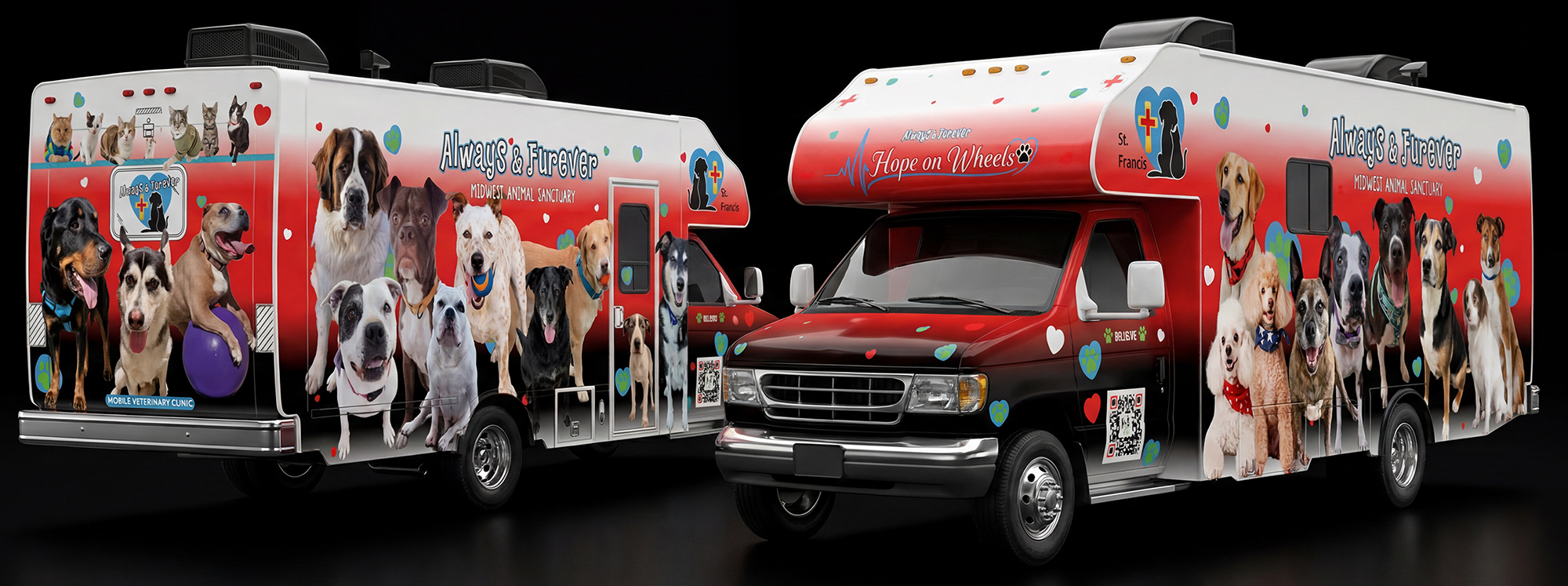
Veterinary Rescue Collaboration Program
A rescue-exclusive veterinary partnership giving approved organizations reliable, affordable access to a fully licensed veterinary team every single month.
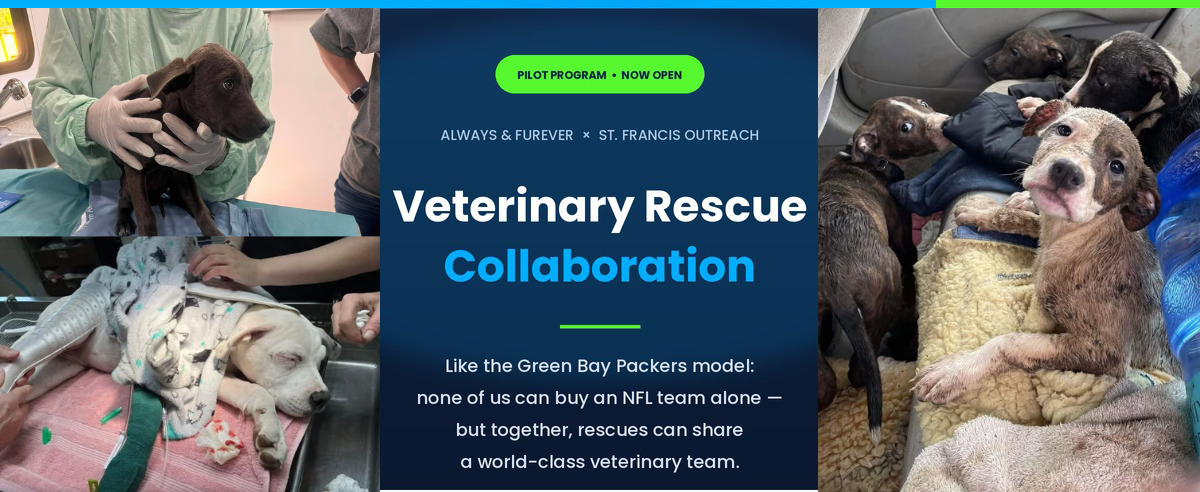
Why We Created This Program
Always & Furever Midwest Animal Sanctuary has always been driven by one mission: to provide lifesaving care to animals who need it most. For years, we've cared for approximately 300 animals daily at our sanctuary and in foster care while also supporting rescue partners across the Kansas City region. But we faced a persistent challenge: unpredictable, high-cost external veterinary expenses that made it difficult to plan, budget, and scale our impact.
Last year alone, we spent $739,352 on external veterinary services—money that flowed out to emergency clinics, specialty practices, and overcrowded veterinary hospitals where our animals often waited for days or weeks for routine procedures. We knew there had to be a better way.
So we built one.
The Veterinary Rescue Collaboration (VRC) Program is our solution: a mission-aligned, invitation-only veterinary partnership program through which veterinary services are provided by St. Francis Outreach, LLC in Kansas and by Always & Furever in Kansas City, Missouri, while extending predictable, affordable access to select rescue partners who share our values and our commitment to animal welfare.
This isn't a traditional veterinary practice. This is a collaboration built on trust, predictability, and shared mission. And we're inviting you to be part of it.
What Makes This Program Different
1. Predictable Access, Not Per-Procedure Pricing
Most veterinary clinics charge per service, which creates financial uncertainty and makes it nearly impossible for rescues to plan ahead. You never know what a case will cost until it's over, and emergency surgeries can wipe out your budget in a single day.
The VRC Program works differently.
You pay a flat monthly retainer based on your tier, and you're guaranteed monthly access to veterinary procedures. No surprise bills. No per-service invoicing. In other words, it's reliable, predictable capacity you can count on every month.
This allows you to:
- Budget with confidence
- Plan your rescue operations around reliable veterinary access
- Save more animals because you know the care will be there when you need it
- Reduce or eliminate costly emergency room visits for routine procedures
2. Cost Transparency and No Profit Motive
Here's what you pay:
- Flat monthly retainer based on your tier
- Medications, lab work, heartworm treatment, and parvo drugs billed at direct cost with no markup
- X-rays billed as program fees: $10 per X-ray, per view
- Ultrasound billed as a program fee: $25 per ultrasound, subject to service availability
- Health certificates at a flat $10 cost
- Sedation costs absorbed by Always & Furever (no separate billing)
3. Mission-Aligned, Not Transactional
This program is invitation-only. We're not trying to maximize volume or scale as quickly as possible. We're building a network of trusted rescue partners who:
- Share our commitment to animal welfare
- Operate transparently and ethically
- Communicate clearly and professionally
- Understand that partner access remains subject to patient welfare, medical judgment, regulatory requirements, and overall program capacity
- Want to collaborate, not just transact
If your organization aligns with those values, we want to talk to you.
4. Flexibility Built Around Real Rescue Operations
- Monthly procedure allocations instead of fixed calendar appointments
- Partners-only program access
- Emergency buffers built into every week
- Vacation planning that maintains access even during staff time off
- Discretionary parvo support when capacity allows (and parvo cases don't count toward your monthly surgical procedure limits)
VRC Locations
St. Francis Outreach, LLC and Always & Furever will provide VRC veterinary services in Kansas at:
- 32874 Beaver Lake Rd, Osawatomie, Kansas (current)
- 5990 Noland Road, Kansas City, Missouri (opening November 2026)
Once the Missouri location is open, partner Allocation Units may be used interchangeably across all participating VRC clinics in Kansas and Missouri.
Pricing Explained
VRC has six pricing buckets to choose from based on individual rescue partner needs.
Bucket 1: Monthly Tier Pricing
Monthly tiers are for rescues that want predictable monthly access. You pay a monthly amount, and that reserves a set number of Allocation Units. You are not buying random procedures. You are reserving access to veterinary capacity.
| Tier | Cost | Choose This If | Monthly AU | Specialty | Plain-English Value |
|---|---|---|---|---|---|
| Tiny Tier | $400/month | You usually have 1 to 2 animals a month that need care and want a small safety net | 2 AU | Up to 1 | Smallest predictable commitment |
| Foster Friend | $750/month | You have a few animals moving through foster every month and want basic care plus room for one harder case | 4 AU | Up to 1 | Turns chaos into a small monthly rhythm |
| Neighborhood Rescue | $1,500/month | You are growing, constantly behind on vetting, and need consistent monthly capacity | 8 AU | Up to 1 | The growth gear for smaller rescues |
| Limited Partner | $2,500/month | You are established enough that a pyometra, dental month, or foreign body could blow up your budget | 10 AU | Up to 2 | Access and stability, not maximum volume |
| Core Partner | $5,000/month | You already spend thousands every month on vet care and need to stop living appointment to appointment | 20 AU | Up to 4 | A dependable operating engine |
| Strategic Partner | $10,000/month | You are a high-volume rescue or shelter and need something closer to a shared in-house surgery service | 40 AU | Up to 10 | Regional-scale capacity and priority |
Specialty uses are inside the total monthly Allocation Units, not in addition to them. Example: Limited Partner has 10 AU total, and up to 2 of those 10 may be specialty uses.
Tier-by-Tier Summary
- Tiny Tier: For about the cost of a couple of bargain surgeries, you lock in access for 2 animals a month and keep a safety net for one harder case.
- Foster Friend: Turns scattered vetting into 4 predictable units of care, including room for one complex case.
- Neighborhood Rescue: At this size, cutting corners no longer saves money. It becomes returns, complications, and long-staying animals. This tier creates a monthly medical rhythm.
- Limited Partner: This is not about squeezing out the cheapest spays. It is about making sure a pyometra, foreign body, senior dental, or colony project does not financially wreck the rescue.
- Core Partner: For rescues already spending thousands a month, this replaces unpredictable GP and ER spending with a repeatable rescue-focused system.
- Strategic Partner: Functions like a shared in-house surgery service without the overhead of building a hospital. Best for high-volume groups with strong scheduling discipline.
Bucket 2: Community Co-op Spay/Neuter Day Shares
| Tier | Cost | Choose This If | Plain-English Value |
|---|---|---|---|
| Community Spay/Neuter Co-op | No monthly fee | You are brand new, tiny, foster-based, or only need occasional spay/neuter help | Pure access. Buy a share when you need it |
This is for rescues that do not want a monthly tier yet, or that have a batch of animals ready. It lets several little rescues share one surgery day so everyone gets access without carrying the full cost alone.
| Package | Capacity | Program Price | Simple Example |
|---|---|---|---|
| Full Cat Day | Up to about 30 cats | $2,250 | About $75/cat if full |
| Half Cat Day | Up to about 15 cats | $1,200 | About $80/cat if full |
| Cat Quarter-Share | Up to about 7 cats | $650 | About $93/cat if full |
| Full Dog Day | Up to about 14 dogs | $2,800 | About $200/dog if full |
| Half Dog Day | Up to about 7 dogs | $1,500 | About $214/dog if full |
| Dog Quarter-Share | About 3 to 4 dogs | $800 | About $200 to $267/dog |
Why This Is Not High-Volume Low-Cost Spay/Neuter
VRC is not trying to be the cheapest spay/neuter option in town. Low-cost clinics are built around volume and price. VRC is built around rescue outcomes, safer anesthesia, predictable access, and the ability to handle cases low-cost clinics often cannot or will not take.
| Issue | Bare-Bones Low-Cost Model | VRC Model |
|---|---|---|
| Goal | Lowest cost per procedure | Best outcome, recovery, and adoptability |
| Monitoring | Minimal monitoring | Continuous monitoring |
| Bloodwork | Often skipped to save cost | Bloodwork when indicated |
| Pain Control | Basic or limited | Pain control before, during, and after |
| Case Mix | Routine only | Routine plus harder rescue cases |
| Rescue Value | Cheap when available | Predictable access and safer planning |
Bucket 3: Specialty Surgery Blocks
Specialty surgery is priced by reserved surgical time, not by the name of the procedure. That matters because one mass removal may take 30 minutes and another may take 2 hours. One dental may be simple and another may be brutal. The fair constraint is time, anesthesia, staff, monitoring, recovery, and the one surgery table.
| Package | Reserved Time | Typical Capacity | Program Price |
|---|---|---|---|
| Stand Alone Specialty | About 90 minutes | 1 complex case | $1,000 |
| Half-Day Specialty Block | About 4 surgical hours | 2 to 3 complex cases | $2,000 |
| Full-Day Specialty Block | About 8 surgical hours | 4 to 6 complex cases | $4,000 |
Real-World Examples
Tiny rescue with cats: A foster-based cat rescue has 7 cats ready for surgery. They do not need a monthly tier yet. They buy a Cat Quarter-Share for $650. Roughly 7 cats are altered in one coordinated day, which is about $93 per cat if the share is full. The rescue avoids waiting for scattered low-cost openings and can move those cats toward adoption faster.
Tiny Tier ($400/month): The rescue has 2 foster animals this month. One needs a spay. One needs an intake exam, vaccines, microchip, and testing. That could use 2 AU. The real value is that if next month a foster dog suddenly has a pyometra, the rescue already has access, a process, and a medical team.
Foster Friend ($750/month): The rescue has 4 animals that need care: 1 dog neuter, 1 cat spay, 1 sick visit for a coughing puppy, and 1 dental with extractions as the specialty case. Instead of calling three clinics, waiting weeks, and guessing the bill, the rescue has a set monthly plan.
Neighborhood Rescue ($1,500/month): The rescue has 8 animals: 4 spays/neuters, 1 intake or sick visit, 1 dental, 1 mass removal, and 1 follow-up or diagnostic case. This is the tier where a rescue starts moving from chaos to planning.
Limited Partner ($2,500/month): The rescue has 10 AU. One real month could be 6 spay/neuter surgeries, 1 dental with extractions, 1 mass removal, 1 sick visit, and 1 imaging appointment. The value is not only savings. The value is that they can say yes to harder animals because they know there is a medical path.
What Is an Allocation Unit (AU)?
Think of 1 Allocation Unit as one meaningful veterinary appointment or procedure slot.
| 1 AU Usually Means | 0 AU May Apply When Bundled | 2 AU May Apply When Longer or Complex |
|---|---|---|
|
|
|
Your Responsibilities as a Partner
Scheduling Requirements
To maintain efficiency and protect medical quality:
- Routine appointments should be requested at least 7 days in advance
- Cancellations require at least 48 hours' notice
- Medical records and case summaries must be submitted at least 24 hours before the appointment
- Partners are responsible for transporting animals to and from treatment location
- Animals must arrive appropriately identified, medically disclosed, and safe to handle and transport
- Same-day discharge should be expected unless the Medical Team communicates otherwise
- Partners are responsible for post-operative placement, monitoring, medication administration, and recovery after discharge
- Animals requiring emergency or overnight care outside program scope must be referred to an appropriate outside provider
Animals remain the legal property and responsibility of the partner organization at all times while receiving care through the VRC Program. Neither St. Francis Outreach, LLC nor Always & Furever assumes ownership, custody, or legal responsibility for partner animals except as expressly provided in the agreement.
Quarterly Reviews and Tier Adjustments
Partner participation and tier alignment are reviewed quarterly by Always & Furever VRC Operations Lead. However, partners may request an earlier adjustment if intake, utilization, or medical needs change materially between review periods. Early adjustments are not automatic and remain subject to Always & Furever approval based on staffing, capacity, and scheduling demands.
Additional Questions?
What happens if I go over my tier?
A rescue can request a tier upgrade, buy an approved standalone specialty block or S/N day share when available, or wait until the next membership month. The extra capacity is not guaranteed unless purchased or approved.
What happens if I do not use everything?
Monthly memberships do not roll over. Annual partners may roll over up to 2 unused AU one month forward. Monthly retainer reserves capacity whether the partner uses every slot or not.
When VRC is not the right fit
VRC is not 24/7 ER, ICU hospitalization, advanced orthopedic hardware, oncology/chemotherapy, or long-term boarding/convalescent care. This protects trust and avoids overpromising.
How this helps you fundraise
Each tier can be offered as a sponsorable monthly care package, turning veterinary expenses into a clear donor opportunity. Donors may also contribute directly through the VRC website, allowing them to see exactly how their support helps provide care.
Foster/adopter confidence
Better medical access helps fosters say yes because they are not afraid of being abandoned with a medical animal and no plan.
How to Apply
Step 1: Review This Document Thoroughly
Make sure you understand:
- The tier structure and what's included
- Your responsibilities as a partner
- Scheduling requirements and flexibility
- Scope limitations and what's not included
Step 2: Assess Your Organization's Fit
Ask yourself:
- Does your mission align with Always & Furever's values?
- Can you commit to professional communication and scheduling discipline?
- Do you have the operational capacity to transport animals and manage post-op care?
- Are you prepared to maintain insurance and meet partner obligations?
Step 3: Submit an Expression of Interest
Contact the VRC Operations Lead to express interest.
Email: vrc@alwaysandfurever.org
Be prepared to share:
- Your organization's mission and history
- Estimated monthly surgical volume
- Current veterinary providers and pain points
- Why you believe this partnership is a good fit
Step 4: Participate in an Intake Call
If your organization is a potential fit, we'll schedule a call to discuss:
- Your specific needs and capacity
- Which tier makes the most sense
- Scheduling logistics and communication protocols
- Next steps for onboarding
Step 5: Onboarding and Agreement Signing
Selected partners will:
- Complete onboarding orientation
- Review and sign the formal Partner Agreement
- Submit required insurance documentation
- Receive access to scheduling systems and communication channels
Ready to Partner With Us?
If your organization is mission-aligned, operationally ready, and committed to ethical, transparent collaboration—let's save more lives together.
Request Partnership Information